Should I Use Puppy Pads for Toilet Training My Cockapoo Puppy?
Posted on 19th February 2026
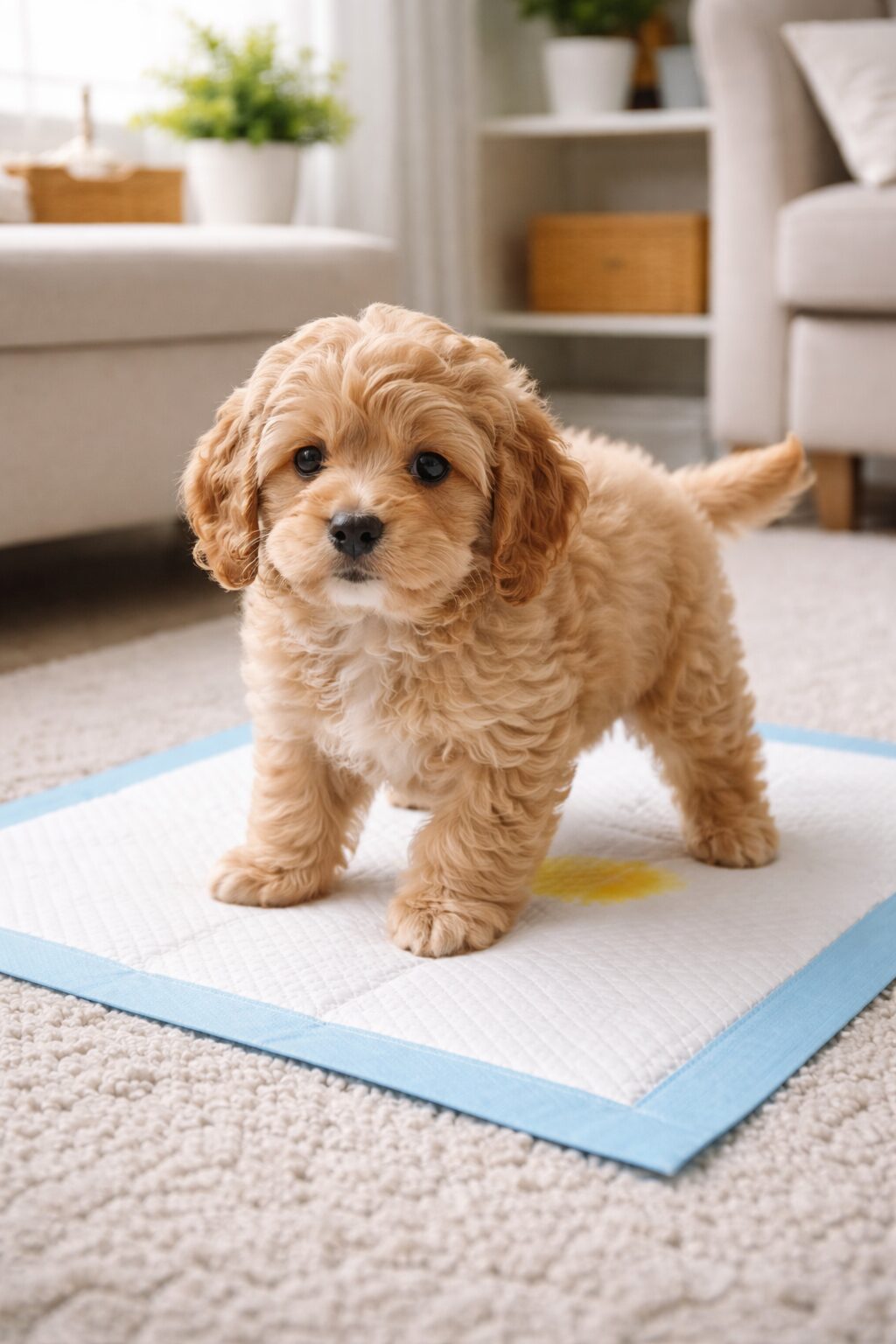
If you’ve just brought home a Cockapoo puppy, puppy pads can look like the simplest answer to toilet training. They can help in specific situations, but they can also slow progress (and create confusion) if they’re used without a plan.
This guide will help you decide whether puppy pads are right for your puppy, how they work, when they’re genuinely useful, and exactly how to transition from pad → door → outside if your end goal is outdoor toileting.
If you want the full step-by-step plan from day one, read my main guide on toilet training your Cockapoo puppy.
Start with what your breeder used
Before you buy anything, find out what surface your puppy has been toileting on at the breeder’s.
- Newspaper / pads: Your puppy may already be used to going on something soft and absorbent.
- Vetbed, towels, blankets: Some puppies learn that “soft = toilet,” which can accidentally generalise to rugs and bathmats in your home.
- Wood pellets / litter tray: Some breeders use a litter-style setup, which can transfer well to a turf box or indoor toilet.
- Outdoor grass: These puppies often transition fastest to outdoor toileting.
Why this matters: puppies learn by repetition and surface preference. If your puppy has only ever toileted on pads, asking them to suddenly target cold, wet grass can feel like a big change—so you’ll need to make the transition gradual.
How puppy pads work (and why scent matters)
Most puppy pads are designed to:
- Absorb quickly so urine doesn’t spread
- Reduce odour
- Encourage repeat toileting in the same spot
Many pads include an attractant. Even without added attractant, the biggest “magnet” is your puppy’s own scent.
When your puppy wees on a pad, the smell becomes a cue: “This is the toilet area.” That’s why pads can create a reliable indoor toilet spot.
But it’s also why pads can backfire if you’re aiming for outdoor toileting: you’re building a strong habit and scent association indoors, then later asking your puppy to break it.
The biggest puppy pad problems (especially for Cockapoos)
1) Puppies rip them up
Cockapoos are bright, mouthy, and often love shredding. Pads move, crinkle, and tear—basically a perfect toy.
If your puppy rips pads up:
- Don’t turn it into a chase game
- Remove the pad calmly
- Swap to a pad holder/tray or a turf box (more on that below)
- Increase supervision and provide a legal chew option
Shredding isn’t “naughty”—it’s normal puppy behaviour. But it makes pads impractical for many homes.
2) Confusion about texture
Pads feel similar to:
- rugs
- bath mats
- door mats
- blankets
So some puppies learn “soft rectangle on the floor = toilet.” That can mean accidents on household items that feel pad-like.
3) Slower transition to outdoors
If your end goal is outdoor toileting, pads can create an extra training step:
- learn to go on pads
- learn to go near the door / on cue
- learn to go outside on grass
That’s not wrong—just longer.
When puppy pads can be genuinely useful
Pads can be a good temporary tool when:
- Apartment living makes quick outdoor access hard
- You have limited mobility or health constraints
- Your puppy isn’t fully vaccinated and you’re avoiding high-dog-traffic areas
- You’re dealing with extreme weather (short-term)
- Your puppy has medical issues causing frequent urination
- You need a safe option for overnight when you can’t take them out
If you choose pads, the key is to use them strategically—not as a default forever solution.
Supervision: the make-or-break factor
Pads don’t replace training. Your puppy still needs:
- frequent opportunities to toilet
- reinforcement for getting it right
- prevention of accidents elsewhere
Practical supervision tips:
- Keep your puppy in the same room as you (or on a house line)
- Take them to their toilet spot after:
- waking
- eating
- drinking
- play
- training
- Reward immediately after they finish (not halfway through)
If you’re using pads, avoid leaving pads everywhere. Multiple pads around the house teaches “toileting indoors is always an option.”
Grab my free toilet training guide so you know exactly when to take your puppy out (and you can spot patterns fast).
A better indoor alternative: a turf box
If you need an indoor toilet, a turf box (real or artificial grass in a tray) is often a smoother bridge to outdoor toileting.
Why it can work better than pads:
- it feels more like grass
- it’s harder to shred
- it reduces confusion with rugs
- it can be moved gradually closer to the door, then outside
If your breeder used pads, a turf box can still work—just expect a short adjustment period and use high reinforcement.
Apartment living: what I recommend
If you’re in a flat and lifts/stairs make toileting trips slow, you have two realistic options:
- Commit to outdoor training and accept you’ll need very frequent trips early on (and a tight management plan)
- Use a designated indoor toilet (ideally a turf box) and plan a gradual transition to outdoors
For many apartment owners, a turf box is the best compromise: it supports hygiene and convenience without strongly teaching “pads are the toilet forever.”
Environmental concerns: pads aren’t biodegradable
Most disposable puppy pads are single-use plastic-heavy products with absorbent polymers. They’re typically not biodegradable, and they create a lot of waste during the weeks (or months) of toilet training.
If sustainability matters to you, consider:
- a washable pad system (still watch for shredding)
- a turf box with washable tray
- committing to outdoor toileting with strong management
Step-by-step: how to transition from pad → door → outside
If you need pads at first but your goal is outdoor toileting, this is the cleanest progression.
Step 1: Use one pad location only (Days 1–3)
- Pick one toilet spot (kitchen corner, utility room, bathroom—wherever is easiest to clean).
- Use a pad holder/tray if possible.
- Take your puppy to the pad on a schedule (after sleep, food, drink, play).
- Reward right after they finish.
Goal: your puppy learns one predictable toilet area, not “anywhere indoors.”
Step 2: Shrink the target (Days 3–7)
If you’ve been using multiple pads, reduce to one. If you’ve been using one large pad, you can:
- fold it slightly smaller, or
- switch to a smaller pad, or
- place the pad in a holder that clearly defines the toilet zone.
Goal: improve accuracy and reduce “near misses.”
Step 3: Move the pad towards the exit (1–2 moves per day)
Every 12–24 hours, move the pad a small distance closer to the door you’ll use for toileting.
- Keep moves small (think: a few feet at a time).
- If accidents start happening, you moved too fast—move it back slightly and slow down.
Goal: the puppy starts heading towards the exit when they need to go.
Step 4: Add a door routine and cue (as soon as you’re near the door)
When you take your puppy to the pad near the door:
- pause at the door for 1–2 seconds
- say your toilet cue (for example, “toilet”)
- then guide them to the pad
Goal: the door + cue becomes part of the toileting sequence.
Step 5: Put the pad outside the door (when you can supervise closely)
Once the pad is right by the door and your puppy is reliably using it, move it:
- just outside the door in the garden, or
- onto a balcony (if that’s your setup), or
- to the outdoor spot you want long-term.
Stay with your puppy. Many puppies hesitate the first few times because the environment feels different.
Goal: toileting happens outdoors, but the familiar pad scent makes it feel “safe.”
Step 6: Swap pad for grass/turf (over 3–10 days)
Now you fade the pad out:
- cut the pad smaller each day, or
- switch to a turf box outside, then onto the lawn
- reward heavily for outdoor success.
Goal: your puppy prefers grass/turf, not the pad.
Step 7: Clean up indoor scent properly
If your puppy has toileted indoors, use an enzymatic cleaner (not just soap/water). Otherwise, leftover scent can keep pulling them back to old spots.
Goal: remove the “this is a toilet” smell from inside.
If you’re doing this transition, my free toilet training guide contains trackers that make it much easier to stay consistent for the first 7–14 days.
If you do use pads, how to avoid getting stuck
- Use one pad location only (not multiple rooms)
- Put the pad in a holder/tray to reduce shredding
- Don’t leave your puppy unsupervised with free access to the whole house
- If you see sniffing/circling, guide them to the toilet spot immediately
And if your puppy has an accident elsewhere, treat it as information: you either missed a cue, waited too long, or gave too much freedom too soon.
So… should you use puppy pads for your Cockapoo puppy?
- If you can get outside quickly and often, you’ll usually toilet train faster by skipping pads and focusing on outdoor habits.
- If you can’t reliably get outside in time (especially in an apartment), pads can help—but a turf box is often a better long-term bridge.
- If your puppy shreds pads or starts toileting on rugs, that’s a sign to switch approach quickly.
If you tell me your puppy’s age, your home setup (house/flat), and what surface the breeder used, I can recommend the cleanest plan for your situation.
FAQs: Should I use puppy pads for toilet training?
Puppy pad FAQ (quick answers)
Do puppy pads confuse toilet training?
They can. Pads teach an indoor toileting habit on a soft surface, which can generalise to rugs and bathmats. If you use pads, keep them in one location and follow a clear transition plan to outdoors.
Will puppy pads make my puppy take longer to toilet train?
Often, yes—because you’re adding an extra step (pad first, then outdoors). If your goal is outdoor toileting and you can get outside quickly, you’ll usually progress faster by skipping pads.
Why does my puppy shred the pad?
Shredding is normal puppy behaviour—pads crinkle, move, and tear like a toy. Use a pad holder/tray, increase supervision, and consider switching to a turf box if shredding continues.
Are puppy pads useful for apartment living?
They can be, especially if stairs/lifts make it hard to get outside in time. A turf box is often a better option because it feels more like grass and can transition outdoors more smoothly.
What should I do if my puppy keeps missing the pad?
Make the toilet area easier: reduce freedom in the house, take your puppy to the pad more frequently, and consider a larger target (or a tray/turf box) until accuracy improves.
How do I stop my puppy going on the rug?
Remove access (baby gates/pen), clean accidents with an enzymatic cleaner, and avoid using pads in multiple rooms. If you’re using pads, keep them well away from rugs and mats.
Are puppy pads bad for the environment?
Most disposable pads aren’t biodegradable and create a lot of waste. If that matters to you, consider a turf box, washable systems, or focusing on outdoor toileting with strong management.
Supporting Blogs:
Teaching Your Cockapoo Puppy to Use Toilet Training Bells
Resources:
The Calm Puppy Reset: Helping Your Cockapoo Puppy Settle, Focus, and Feel Safe
Help! My Puppy is a Landshark Webinar
Freebies:
The Cockapoo Puppy 7 Day Guide
3 Minute Morning Reset Guide