My Cockapoo Puppy Is Biting the Children: Why It Happens and How to Fix It
Posted on 12th June 2026
You got a puppy for the family. You imagined the dog growing up alongside your children — playing in the garden, sleeping at their feet, becoming part of the furniture of their childhood.
And now the children don’t want to go near the puppy.
Maybe the biting started small — a nip here, a grab at a sleeve there. Maybe it escalated quickly and now your kids are retreating to the other side of the room the moment the puppy appears. Maybe someone has already cried. Maybe you have too.
I want you to know two things before we go any further.
First: this is one of the most common things I hear from Cockapoo families. You are not the only one. Second: it is fixable. Not eventually, not with years of work — with a clear understanding of what is actually happening and a few practical shifts you can start today.
Why Is My Cockapoo Puppy Biting the Children?
Before you can fix it, you need to understand what is driving it. Because “puppy biting children” is not one problem. It is almost always one of three things happening, and they each need a different response.
1. Your puppy is overstimulated
Children are, from a puppy’s perspective, the most exciting thing in the house.
They move unpredictably. They make high-pitched noises. They run, shriek, wave their arms, and change direction without warning. To a puppy whose nervous system is already running hot, children are like a firework display that never ends.
Overstimulation stacks. Every walk, every visitor, every exciting interaction earlier in the day has added to the load your puppy is already carrying. By the time the children come home from school or start playing after tea, your puppy’s threshold is already close to its limit. Children tip it over.
The result looks like aggression. It is not. It is a puppy whose self-regulation has completely run out.
2. Your puppy is overtired
Young Cockapoo puppies need 16–18 hours of sleep every day. Most are getting far less. And an overtired Cockapoo does not go quiet and sleepy — they become frantic, bitey, and completely unable to regulate themselves.
Overtired biting is often the worst kind because it escalates quickly. The more you intervene, the more wound up the puppy gets. The more wound up the puppy gets, the harder they bite. The children get upset. The puppy escalates further.
If the biting at children is worst in the evenings, tiredness is almost certainly the primary driver. Read more about this in why your Cockapoo puppy gets worse in the evenings.
3. Your puppy is in play mode and losing inhibition
Some puppies are not overtired or overstimulated — they are simply in full play mode and have lost their bite inhibition around children because children respond in ways that accidentally reward the biting.
When a child shrieks and runs away, the puppy learns: this is a fantastic game. When a child waves their hands to push the puppy away, the puppy learns: movement means play. When a child freezes in fear, the puppy often continues — they are not reading the social cue the way another dog would.
This is not your puppy being malicious. It is your puppy doing exactly what puppies do — and your children doing exactly what children do — and the two things combining into something that feels frightening.
Still dealing with the biting?
If you're here, chances are it's still happening. Take the free Puppy Biting Quiz to find out exactly where your puppy sits — and what actually helps next.
What Not to Do When Your Puppy Bites the Children
This matters as much as the fix. Several common responses make the situation worse, not better.
| Do not shout or physically intervene in the moment.
Loud voices and sudden movement look exactly like play escalation to an already-excited puppy. Shouting at a biting puppy almost always makes the biting worse in that moment. |
| Do not let children try to ‘correct’ the puppy themselves.
Pushing, tapping on the nose, holding the muzzle closed — children cannot apply these consistently, and inconsistency teaches the puppy nothing useful. It also puts children in physical confrontation with a biting puppy, which is not a safe place for either of them. |
| Do not simply separate them long term.
Keeping the puppy away from the children entirely solves nothing and creates a dog who never learns to be calm around children. The goal is a puppy who can be around children safely — and that only comes from structured, calm practice. |
How to Stop Your Cockapoo Puppy Biting the Children
Here is what actually works. These are the shifts I walk families through most often — and the ones that make the biggest difference the fastest.
Step 1: Bring the energy down before the puppy gets near the children
This is the single most effective change most families can make, and it costs nothing.
Before any interaction between puppy and children, your puppy needs to be calm. Not ‘calm enough’ — actually settled. That means:
- A toilet trip has happened
- They have had a proper rest beforehand — not just five minutes in the crate
- There has been no exciting play in the 20–30 minutes before
- The environment is quiet — no loud TV, no rushing around
A calm puppy going into an interaction with children is a completely different animal from an already-buzzing puppy being launched into chaos. Most families are doing the second thing without realising it.
Step 2: Give children a job
Children being passive recipients of a puppy’s attention is a recipe for biting. Children with a job are a different thing entirely.
The job can be simple:
- Standing still and letting the puppy sniff their hand
- Offering a treat from a flat palm when the puppy is calm
- Holding a toy at arm’s length for the puppy to target instead of hands
- Turning away calmly the moment the puppy gets mouthy
Children who have something to do feel less helpless. And a puppy who is getting clear, consistent signals from children — calm gets attention, mouthy gets ignored — starts to learn what works.
Keep sessions short. Two to three minutes of calm interaction is worth far more than twenty minutes of chaos.
Step 3: Have a clear, calm way to end every interaction
Most interactions between puppies and children end badly because there is no plan for how to end them well. The puppy gets overexcited, biting starts, someone shouts, someone cries, the puppy escalates.
Before any interaction starts, decide in advance how it ends. That might mean:
- A calm ‘that’s enough’ signal that children know to use
- An adult stepping in to redirect the puppy to their crate or pen before the biting starts
- Children leaving the room calmly rather than running — running triggers chase
Ending on calm is the goal. Even if the session was very short. Especially if the session was very short.
Step 4: Manage the environment, not just the behaviour
You cannot train your way out of a management problem. If your puppy has free access to children all day, every day, with no structure — the biting will continue regardless of how consistent you are in the moments it happens.
Practical management looks like:
- Using a pen or crate to give the puppy enforced rest before children come home
- Baby gates that separate spaces without creating total isolation
- A safe space the puppy can go to that children know not to approach
- Structured interaction times rather than constant access
Management is not a failure. It is how you create the conditions for training to work.
Step 5: Reduce stimulation across the whole day
If the biting is worst around children in the evenings, look at the whole day — not just the evenings.
Stimulation stacks. A puppy who has had a big walk, several visitors, lots of play and a training session by 3pm is already near their threshold before your children have even got through the door. Calmer days mean calmer evenings. That does not mean boring days — it means deliberate ones.
The 5 signs your Cockapoo puppy is overtired is worth reading if you are not sure whether tiredness is the main driver.
What to Tell Your Children
Children who understand what is happening cope much better than children who just feel frightened.
Some things that are genuinely helpful to explain, in simple terms:
- The puppy is not being mean. They are playing the only way they know how right now.
- Their teeth are how they learn about the world. Like how you touched everything with your hands when you were a baby.
- When the puppy gets mouthy, be a tree — stand still, arms in, no squeaking. Running and shouting makes it more fun for them.
- The puppy is going to get better at this. It will not always be like this.
That last one matters. Children who believe this stage is permanent are more distressed than children who understand it is temporary. Give them a timeline they can hold onto: most puppies are noticeably calmer by five to six months. That is not far away.
When to Get More Help
The approach above works for the vast majority of puppy biting around children. But there are situations where more targeted support is the right call.
Consider getting proper help if:
- The biting is leaving marks or breaking skin regularly
- Your puppy is showing stiffness, hard staring, or growling that feels different from play
- You have tried the steps above consistently for two to three weeks with no improvement
- A child is genuinely frightened and the family situation is becoming seriously strained
None of the above automatically means something is seriously wrong with your puppy. But they are signs you would benefit from a set of eyes on the situation. My 1:1 support is available for exactly this — a proper look at what is happening and a plan built around your family, not a generic guide.
Or contact a specialist trainer at Kids Around Dogs who have lots of trainers in lots of areas of the UK
The Calm Evening Checklist: Your Simple Reference
Everything above is captured in the free Calm Cockapoo Evening Checklist, which you can download and keep on your fridge, save to your phone, or share with anyone else in the house helping with puppy routines.
It covers all four stages — Before Dinner, After Dinner, Wind Down, and Bedtime — plus the six most common normal-but-alarming evening behaviours so you know what to look for and what is actually going on when your puppy starts climbing the walls at 7pm.
It is completely free. No strings.
Final thoughts
Getting a puppy and finding that the children are struggling is one of the most quietly difficult things a family can go through. The gap between what you imagined and what is actually happening can feel enormous.
But your puppy is not broken. Your children are not unusually sensitive. And you have not made a mistake.
You are in the hardest few weeks of puppyhood, with a sensitive, clever, people-focused little dog who has not yet learned how to be around the small, loud, unpredictable people they are genuinely desperate to be close to.
The calm comes. It always does.
Start with one thing from this post today. Lower the stimulation before they interact. Give the children a job. Have a plan for ending the session well.
That is how calm Cockapoo families are made. One small, doable shift at a time.
— Clair
Founder, Cockapoo52
Supporting Blogs:
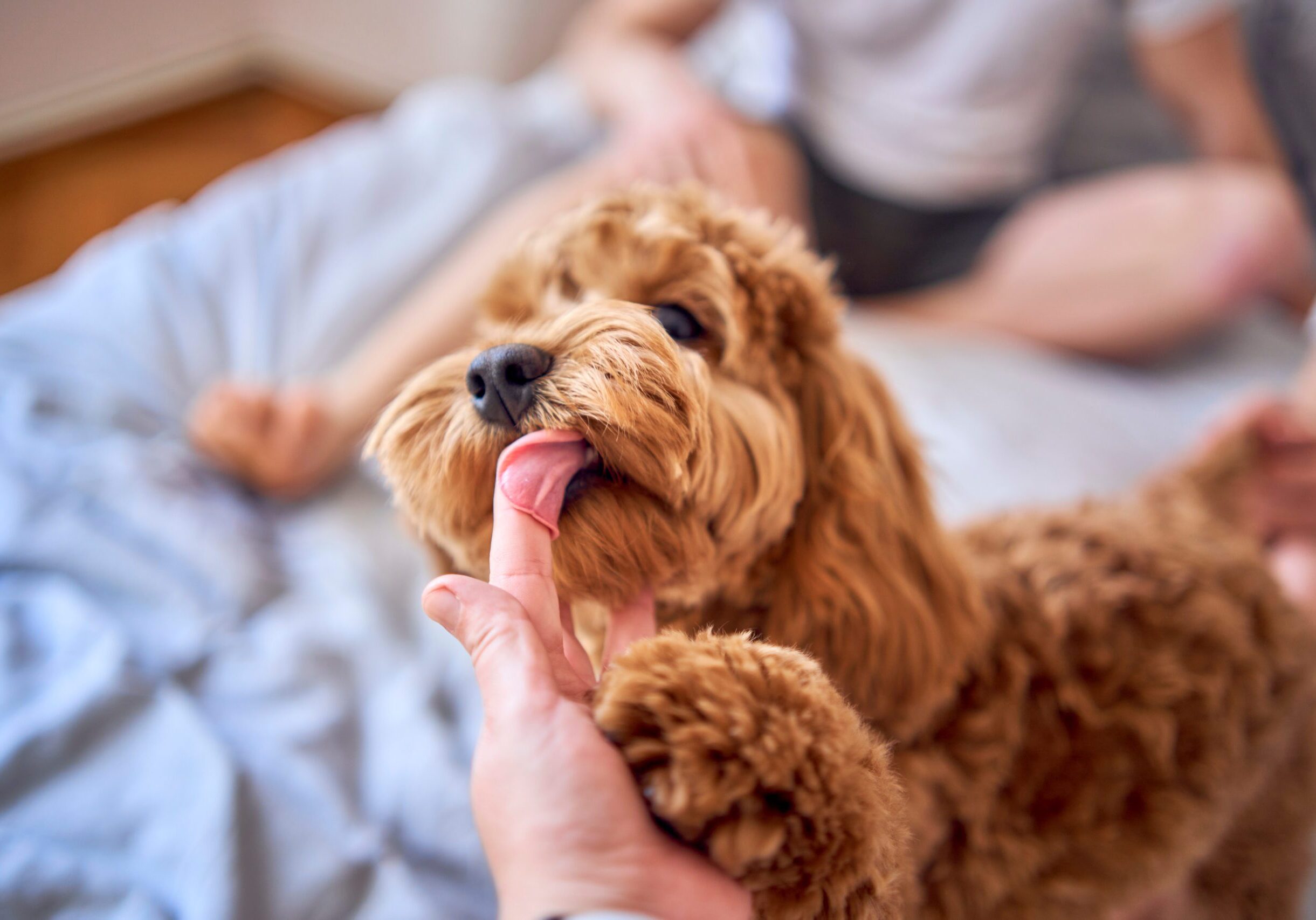
How to Stop Cockapoo Puppy Biting: Why Cockapoo Puppies Bite & Proven Solutions
Resources:

Stop the Evening Chaos: Helping Your Cockapoo Puppy Settle, Focus, and Feel Safe
Freebies:
The Cockapoo Specific Sleep Training Guide

Watch on YouTube

How to Stop Cockapoo Puppy Biting (Without Making It Worse)