Why Does My Cockapoo Puppy Bite My Ankles and Feet?
Posted on 27th October 2026

You get up to put the kettle on. Three steps in, there's a puppy hanging off your trouser leg. You turn round, they let go, you take another step, and they're back. By the time you reach the kitchen you've got a small, delighted Cockapoo attached to your sock and a mug of patience that's running very low.
Ankle biting is one of the most common things Cockapoo owners ask me about, and one of the most wearing. It's not the hardest bite, but it's relentless. It happens every time you move, and it can make you feel like you can't walk across your own house.
Here's the reframe: your puppy isn't attacking you. Your feet are the most exciting moving thing in the room, and right now they're winning a game you didn't know you were playing. That's fixable.
In this post I'll cover why puppies go for ankles and feet, why it gets worse at certain times of day, exactly what to do in the moment, and what to stop doing.
Why Does My Puppy Bite My Feet When I Walk?
Because moving things are irresistible to a young puppy, and Cockapoos are built to notice movement. You've got spaniel and poodle in there: two clever, busy breeds that love to chase, grab and carry.
To your puppy, a foot moving across the floor looks a lot like a toy being dragged along. Trouser legs and dressing gown cords flap. Slippers squeak and slide. All of it says "catch me".
Then there's the reaction. When a puppy grabs your ankle, most people squeal, hop, shake their foot or try to walk faster. From your puppy's side, the toy just got more exciting. That's why ankle biting can go from occasional to constant in a week. Every reaction is a reward.
Is It Normal for a Puppy to Bite Your Ankles?
Yes. Ankle and foot biting is very common between around 8 and 16 weeks, and it's part of normal puppy mouthing. Puppies explore the world with their mouths, and they play with their littermates by chasing and grabbing. You're simply the new littermate.
Normal doesn't mean you should wait it out, though. Before I teach a puppy anything, I ask one question: what is the future of this behaviour? A ten-week puppy swinging off your sock is funny. A one-year-old Cockapoo grabbing a visitor's ankles as they walk in, or chasing a toddler's feet across the garden, isn't. Whatever your puppy practises now is what they'll do later.
Dealing with puppy biting?
If you're here, chances are it's happening. Take the free Puppy Biting Quiz to find out exactly where your puppy sits — and what actually helps next.
Why Is My Puppy's Ankle Biting Worse in the Evening?
If the ankle biting seems to switch on at teatime, you're not imagining it. Most puppies are at their most bitey in the evening, and it's rarely about the feet themselves. It's about how full their tank is.
Stimulation stacks. By late afternoon your puppy has had a whole day of new sounds, people, smells and play. Add a missed nap and you've got a puppy who can't switch off, and the fastest-moving thing in the room gets the overflow. I go into this in detail in why your Cockapoo puppy gets worse in the evenings.
Ask yourself before you do anything else: when did my puppy last sleep properly? If the answer is "a while ago", the fix is a nap, not training. These 5 signs your Cockapoo puppy is overtired will help you spot it earlier. Tired is not the goal; rested is
How Do I Stop My Puppy Biting My Ankles?
You're aiming for two things: make your feet boring, and give your puppy something better to do with the energy. Here's what I'd do, in this order.
- Stop being the toy
The moment your puppy grabs your ankle, go still. No squeal, no shake, no hopping. Moving feet are fun; still feet aren't. Most puppies let go within a few seconds when the game stops.
- Freeze, stay quiet, and keep your hands out of it
- As soon as they let go, calmly carry on
- If they grab again, freeze again. Consistency is what makes it work.
- Give them something better to chase
Your puppy needs that chase-and-grab energy to go somewhere. Give it a legal outlet.
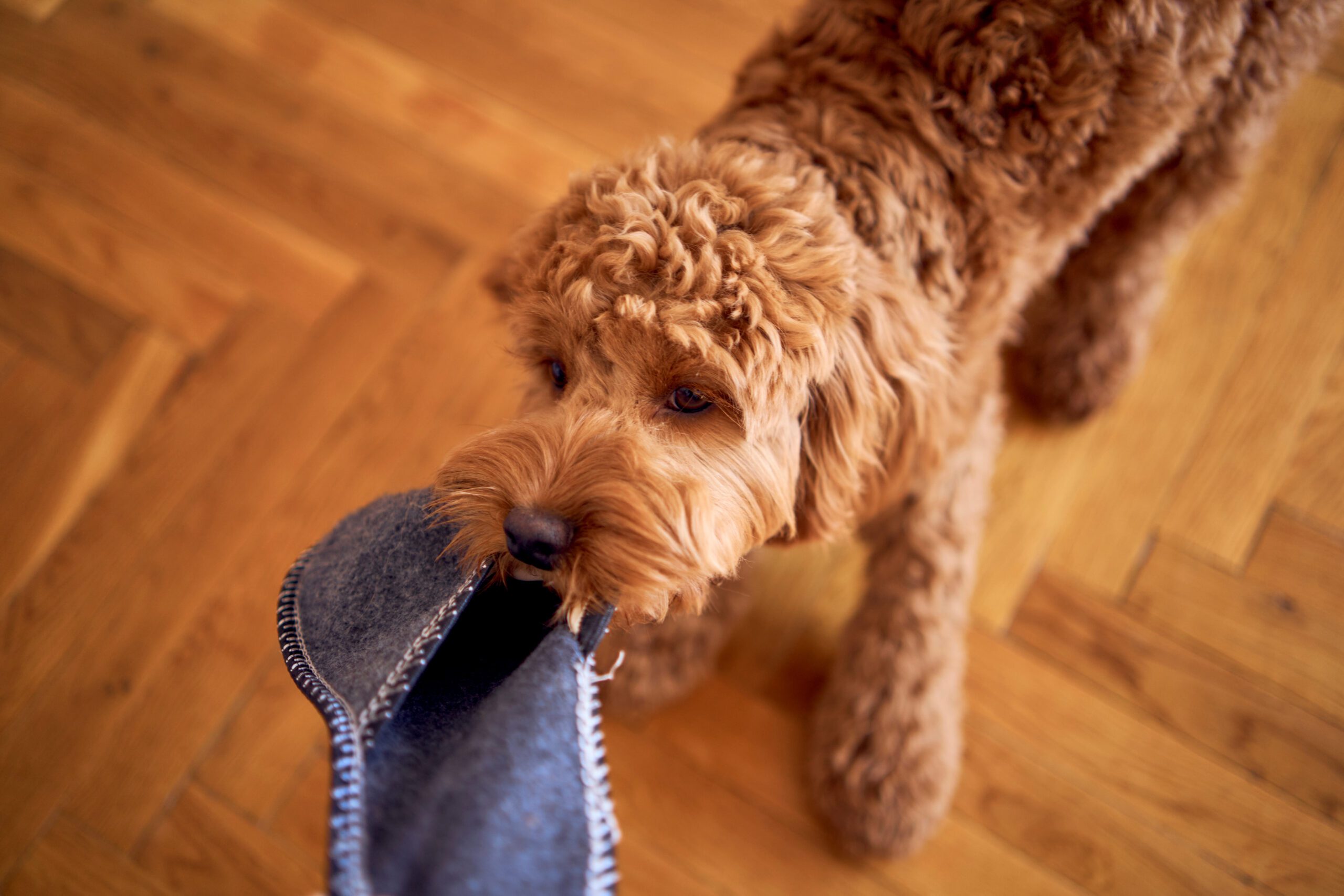
- Keep a long, soft tug toy somewhere you can reach it easily
- When your puppy lets go of your foot, drag the toy along the floor away from you and let them catch it
- Play for a minute, then end it calmly. Short bursts work better than a long, wild game.
This isn't rewarding the biting. You're showing your puppy where the chase game lives. My post on why Cockapoo puppies bite during play covers how to keep games from tipping over.
- Manage the hot spots
Most ankle biting happens in the same few places at the same few times: the walk from the sofa to the kitchen, cooking tea, getting ready in the morning. Don't try to train through all of them at once.
- Swap fluffy slippers and floaty trousers for something less tempting for a few weeks
- Pop your puppy behind a gate or in their pen with a chew when you need to move around a lot, such as while cooking
- Give them a chew or a food toy before the busy moment starts, not after the biting has begun
This is management, not giving in. Every ankle bite your puppy doesn't practise is one that won't become a habit.
- Reward calm feet
Catch your puppy getting it right. When you stand up or walk a few steps and your puppy stays calm, with four paws on the floor and no grabbing, drop a treat by their front paws.
- Start tiny: one step, then a treat
- Build up to a few steps, then across the room
- Keep the rewards low and calm, at floor level, so you aren't winding them back up
What Not to Do When Your Puppy Bites Your Feet
Some of the most common advice makes ankle biting worse. Avoid these:
- Squealing or shouting. It adds noise and excitement, which is exactly what your puppy wanted.
- Running away. You've just started the best chase game in the house.
- Pushing them off with your foot. A foot coming towards them is still a moving toy, and it can scare a sensitive puppy.
- Saying "no" over and over. "No" means nothing to your puppy on its own. It only takes on whatever happens straight after it, and if that's more movement, it becomes part of the game.
- Telling them off after the fact. Your puppy can't link a telling-off to a bite that happened seconds ago.
Supporting Blogs:
The Calm Cockapoo Evening Routine: A Step-by-Step Guide for Settled Nights
Resources:
The Cockapoo Puppy Biting Toolkit
Freebies:
The Cockapoo Puppy Home Alone Guide
Watch on YouTube

The 4 Types of Puppy Biting (And Why the Toy Swap Fails)
Why This Matters
Ankle biting looks like a small, annoying habit. But underneath it is the bigger skill your puppy is learning: how to stay calm when something exciting moves past them.
That's the same skill they'll need when a jogger goes by, when a child runs across the park, or when a visitor walks through the door. Teach it now, in your kitchen, and you're building the calm Cockapoo you'll be living with for the next fifteen years.
Your Puppy Isn't Attacking You
If your ankles are covered in tiny scratches right now, you're not doing anything wrong and your puppy isn't naughty. You've got a clever, busy puppy who found the best game in the house. Your job is to quietly change the rules.
Start with one thing today: the next time your puppy grabs your ankle, go completely still and wait for them to let go. That's it. That one change takes away most of the fun.
If you want exactly what to do in the moment, plus the exercises that build calm and impulse control so this happens less, the Puppy Biting Toolkit is built for this. It's £9, with a one-week guarantee.
— Clair
Founder, Cockapoo52